
Everyday Nutrition
Fibre, Fluids, and the Rhythm of an Everyday Plate
Tobias Whitfield · 3 March 2026 · 9 min read
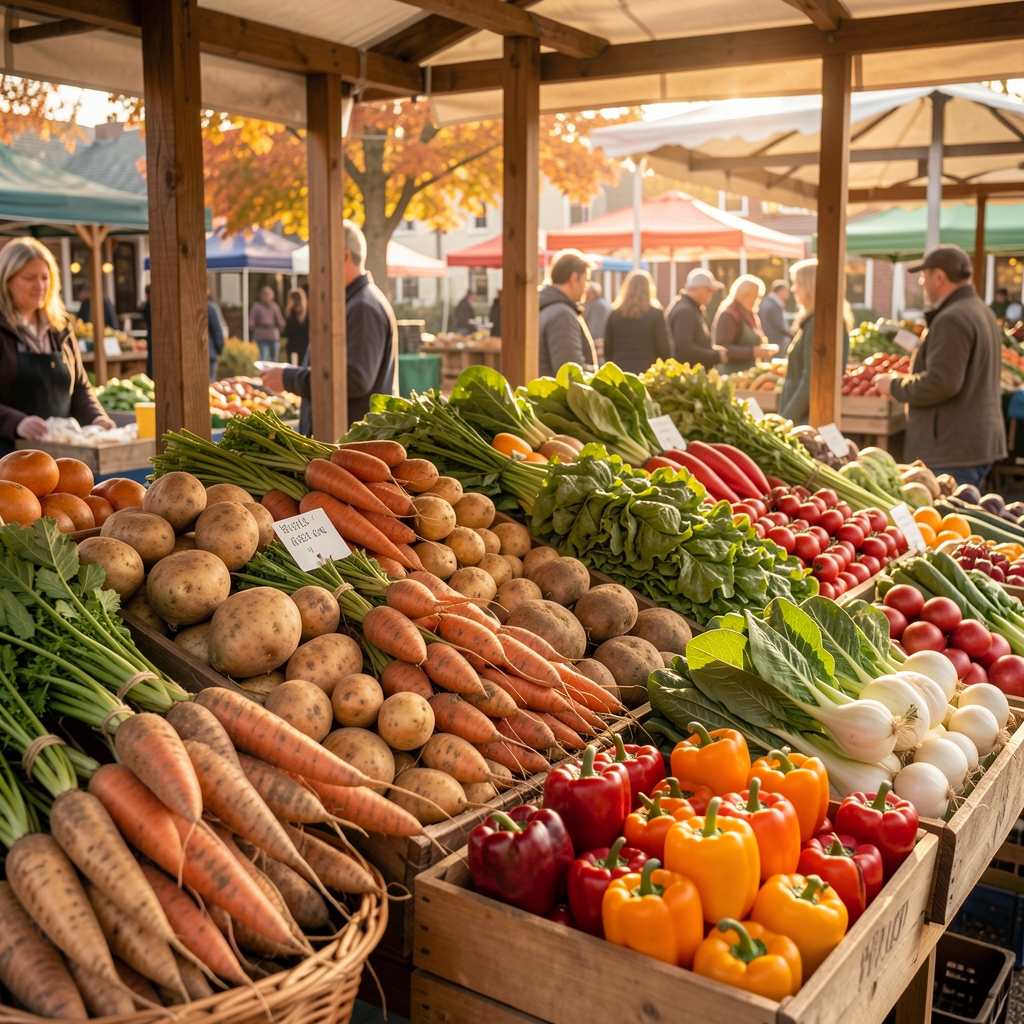
There is a particular economy to cooking with what the season offers. Autumn root vegetables bring not only warmth to the table but a structural simplicity — the kind that makes weekly meal preparation feel less like a discipline and more like a considered habit. The same logic applies, with some adjustment, across every turn of the calendar. Seasonal produce is not a romantic notion; it is, in the most practical sense, an organisational one.
Walk through a large supermarket in any month of the year and the produce section looks broadly the same. Tomatoes in February, strawberries in October, courgettes in December. This consistency, which is often described as a benefit of modern supply chains, has a significant nutritional implication that is rarely acknowledged in everyday conversation: it trains the home cook toward a fixed repertoire.
A fixed repertoire means a narrowing range of nutrients. The dietary guidelines published by Public Health England — and subsequently adapted into the NHS Eatwell Guide — consistently emphasise variety as a meaningful component of a balanced diet. Variety here refers not only to the categories of food (protein, carbohydrate, fat) but to the diversity of specific vegetables and fruits consumed across a week. A household that eats the same five vegetables across all twelve months of the year is, by definition, restricting its range without necessarily being aware of doing so.
Seasonal eating introduces the year's natural rhythm as a mechanism for enforcing variety. Not by directive, but by availability. When parsnips and squash are at their best and most affordable in late autumn, a thoughtful cook reaches for them. When asparagus arrives in late spring — brief, local, and better than its imported counterpart in any month — it changes what goes on the plate. This is variety imposed not by a nutrition plan but by the calendar.
There is a point in the life of any fruit or vegetable when its nutritional content is at its highest. That point is, broadly speaking, around harvest. The time elapsed between harvest and consumption — and the conditions of storage and transport during that interval — affects how much of the original nutrient content reaches the plate.
This is not a fringe observation. Research published in the British Journal of Nutrition has documented measurable differences in certain micronutrient levels between locally grown, recently harvested produce and the imported equivalent transported under refrigeration over several days. The differences are not uniform across all nutrients — some are more stable than others during transit — but the general principle holds: fresher, more proximate produce tends to retain more of what was there at harvest.
For the home cook, this has a practical implication: shopping for what is locally in season, particularly at farmers' markets or through weekly box schemes, is likely to mean food that has spent less time between field and kitchen. This is not a guarantee of superior nutrition in every individual case. It is, however, a structural tendency that favours the seasonal shopper.
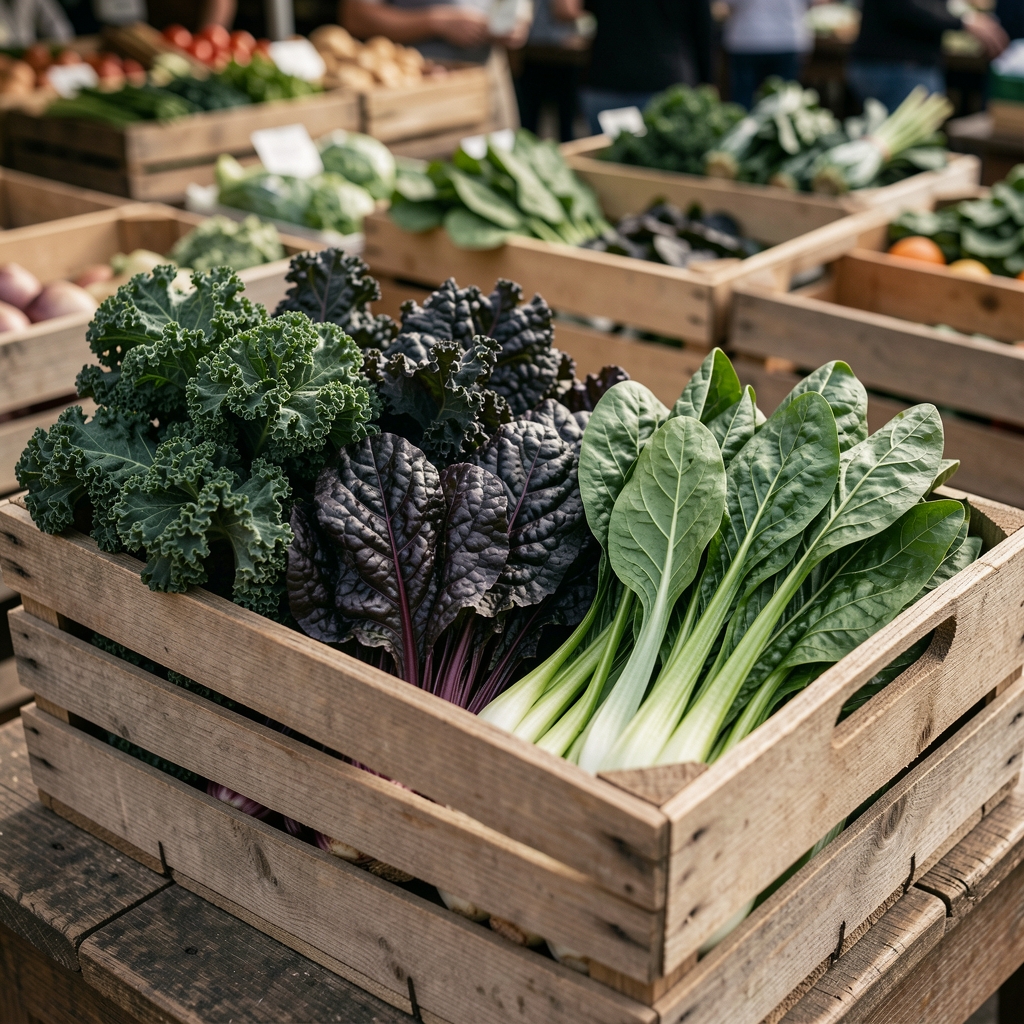
Field harvest. Leafy greens from a UK market garden, photographed in early spring.
Meal planning has attracted a great deal of attention in nutritional discourse, mostly because the research on its benefits is consistent. Those who plan their meals in advance tend to consume a broader variety of food groups, purchase more vegetables per shopping trip, waste less produce, and maintain a more stable pattern of calorie awareness than those who cook without planning. The food journal — whether analogue or digital — amplifies this effect: recording what was eaten, when, and in what proportion makes the invisible visible.
A seasonal approach can be built directly into the weekly menu. The method is simple: before writing the week's plan, consult what is currently at its seasonal peak. In January, that might mean celeriac, leeks, and purple sprouting broccoli. In July, courgettes, green beans, and British tomatoes. These become the structural vegetables around which the rest of the plan is constructed. Protein sources, grains, and cooking methods are chosen to complement what the season has led you to.
This approach does something that purely nutrition-led planning sometimes fails to do: it gives the plan a reason to exist beyond the management of dietary numbers. There is an aesthetic argument for seasonal cooking, one that connects the table to a wider world, and that argument turns out to be nutritionally valid as well.
The phrase "whole foods" has accumulated a great deal of marketing weight, to the point where its actual meaning — food that is minimally processed and close to its original form — is sometimes obscured by its commercial associations. In the context of seasonal cooking, it is worth recovering the original sense: a whole vegetable from a local harvest is as close to its original form as food gets in a domestic kitchen.
Processing — including extended storage, refrigeration during transport, and exposure to oxygen — changes the character of food in ways that go beyond nutrient loss. Texture, flavour, and the specific combinations of compounds that make a particular vegetable worth eating all shift over time. A well-stored parsnip in February is a perfectly adequate vegetable. A freshly dug parsnip in October from a field in Kent is a different experience, and that difference is nutritionally legible as well as sensory.
Incorporating seasonal whole foods into a weekly meal plan is not a demand for perfection. Most households in the UK cannot realistically source everything from a local harvest. The point is directional: moving the balance of what lands in the kitchen toward the seasonal and the whole is a structural improvement that does not require rigid rules to achieve.
One often-overlooked aspect of seasonal cooking is its effect on portion habits. Foods that are genuinely in season tend to arrive at the kitchen in larger, more irregular quantities — a whole celeriac, a head of cauliflower, a bunch of rainbow chard — than the pre-portioned bags that dominate the supermarket produce aisle. This has an interesting effect on how cooks approach the meal.
When the vegetable component of a meal arrives as a whole, unpackaged object, the cook makes active decisions about how much to use, how to prepare the remainder, and how to build subsequent meals around what is left. This is, in miniature, an education in portion awareness that no app or nutrition label quite replicates. The food is present; its scale is visible; the decision about quantity is taken deliberately rather than by default.
Over time, this deliberateness accumulates. The cook who has spent a winter working through a weekly box of seasonal vegetables — deciding how to use a large squash across three dinners, how to incorporate kale into a soup and a salad and a grain bowl — is practicing a form of portion awareness that is neither restrictive nor mathematical. It is, rather, attentive. That attentiveness, the nutritional literature suggests, tends to produce better dietary outcomes than adherence to any specific numerical target.
Water content varies significantly across vegetables and across seasons. Summer produce — cucumbers, tomatoes, courgettes, lettuces — tends toward high water content. Winter root vegetables are denser, lower in water, and more calorie-concentrated per gram. This has an implication for hydration habits that is seldom discussed in nutritional writing aimed at a general audience.
In summer months, a diet rich in seasonal produce contributes meaningfully to overall fluid intake through the food itself. This does not replace the need for direct hydration — the standard guidance of six to eight cups of fluid per day remains valid — but it adds a quiet supplement to total intake. In winter, when the produce is denser and the ambient temperature encourages indoor heating that depletes atmospheric moisture, the need for deliberate hydration is somewhat greater. Awareness of this shift is a small, practical piece of nutritional knowledge that seasonal cooks tend to develop naturally.
For those who find the idea of seasonal cooking daunting — uncertain where to begin, unfamiliar with what is actually in season when — the simplest entry point is a single substitution. Next week, when writing the meal plan, identify one vegetable that appears on the plan regardless of season (the reliable bag of washed spinach, the packet of cherry tomatoes) and replace it with whatever is demonstrably in peak UK season that week.
The Soil Association publishes a reliable seasonal calendar for British produce. BBC Good Food maintains an accessible version of the same. Choosing a single seasonal substitution per week is an achievable practice that, over the course of a year, changes the character of the entire dietary pattern without requiring any radical revision of cooking habits.
The season is not a constraint. It is, in the most useful sense, a menu — one that has been composed by forces more patient and more knowledgeable than any individual nutritional plan.